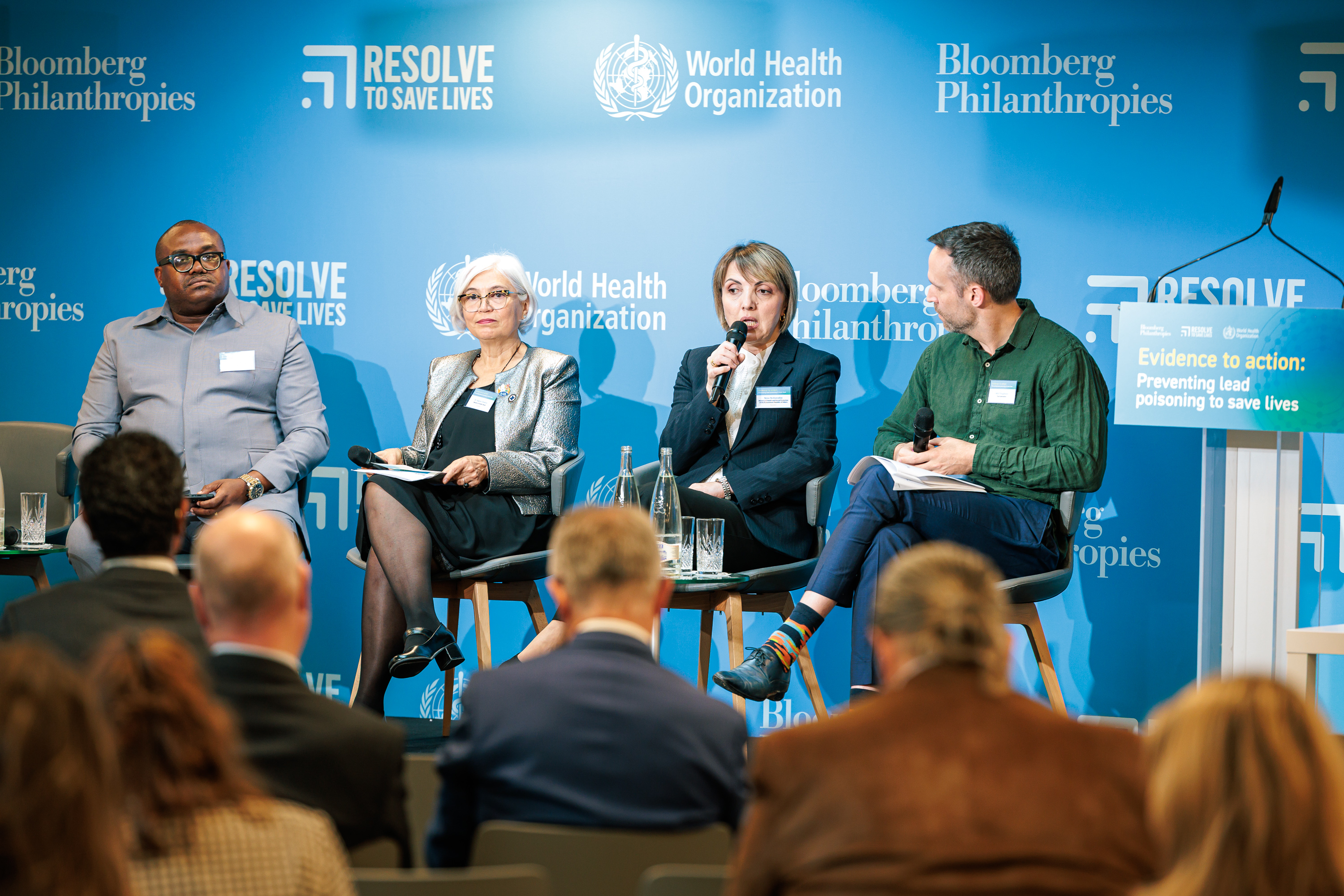
Resolve to Save Lives, the World Health Organization (WHO), and Bloomberg Philanthropies convened health leaders alongside the 79th World Health Assembly to introduce PREVENT, WHO’s forthcoming technical package on lead poisoning prevention.
“From evidence to action: Preventing lead poisoning to save lives” highlighted the overview module—recently published as a discussion paper – and featured dialogue between national and global health leaders about the urgency of lead poisoning prevention and the way forward.
Key takeaways
- Country experiences: Health ministers and senior officials from Brazil, Georgia, and Ghana discussed how they moved from recognizing lead poisoning as a problem to mobilizing policy responses and funding. Common themes included the need for reliable data to galvanize action; the value of engaging multiple ministries, including environment, trade and finance; and the importance of community-level communication to address an often-invisible hazard.
- Global partnerships: Event co-organizers reinforced the urgency of the issue: the time to act on lead poisoning prevention is now. Both WHO Director-General Dr Tedros (in a prerecorded video message) and Dr Ruediger Krech, Director for Environment, Climate Change, Migration and One Health, emphasized WHO’s commitment to the issue and held up the forthcoming technical package as a way forward for countries. Dr Tom Frieden, President and CEO of Resolve to Save Lives, called on countries to use the technical package to move from commitment to action. Apala Guhathakurta, a member of the Public Health team at Bloomberg Philanthropies, underscored the importance of public-private partnerships to catalyze change.
- Next steps: Ahead of the 2027 release of the PREVENT technical package, WHO will organize a series of consultations with Member States, WHO regional offices, and technical partners. Countries and other stakeholders are invited to review the overview module discussion paper.