At a glance

Challenge: Moving from broad strategy to concrete action on lead
Over the past two decades, lead exposure has become an urgent public health issue in Nigeria. In addition to lead exposure from some paints used in homes, schools, and playgrounds, large-scale lead poisoning outbreaks tied to mining and car battery recycling have also contributed to thousands of deaths in recent years.
In 2024, Nigeria’s Federal Ministry of Health and Social Welfare (FMHSW) began developing a first-of-its-kind national policy and action plan for lead elimination, in collaboration with government ministries, state and local governments, and the private and public sectors. Resolve to Save Lives (RTSL) provided technical assistance, including support with research and analysis, coordination and partner alignment, and policy development. The action plan, which puts forth comprehensive strategies to strengthen lead poisoning prevention, regulation, and enforcement activities, signaled a strong commitment from the Nigerian government and marked an important step toward building towards a lead-free Nigeria.
But for such a broad, comprehensive action plan that covers an environmental health issue with such diverse sources of exposure, implementation to prevent lead exposure at any one source—from testing capacity to regulations to surveillance—would be especially challenging.
No safe level
Lead is toxic at any level of exposure, yet remains common in everyday items such as paint, cosmetics, spices, cookware, and toys. Lead exposure has serious health risks for adults and children including anemia, hypertension, and kidney and heart disease. For children, early lead exposure causes cognitive delays and behavioral disorders that carry into adulthood and can cost countries billions of dollars in lost GDP. Exposure in women before or during pregnancy can lead to miscarriage, stillbirth, and increases the risk of premature birth and low birth weight. Because exposure is often invisible, most affected communities don’t know they’re at risk.
Solution: Leveraging lessons learned and pre-existing partnerships to focus lead elimination efforts
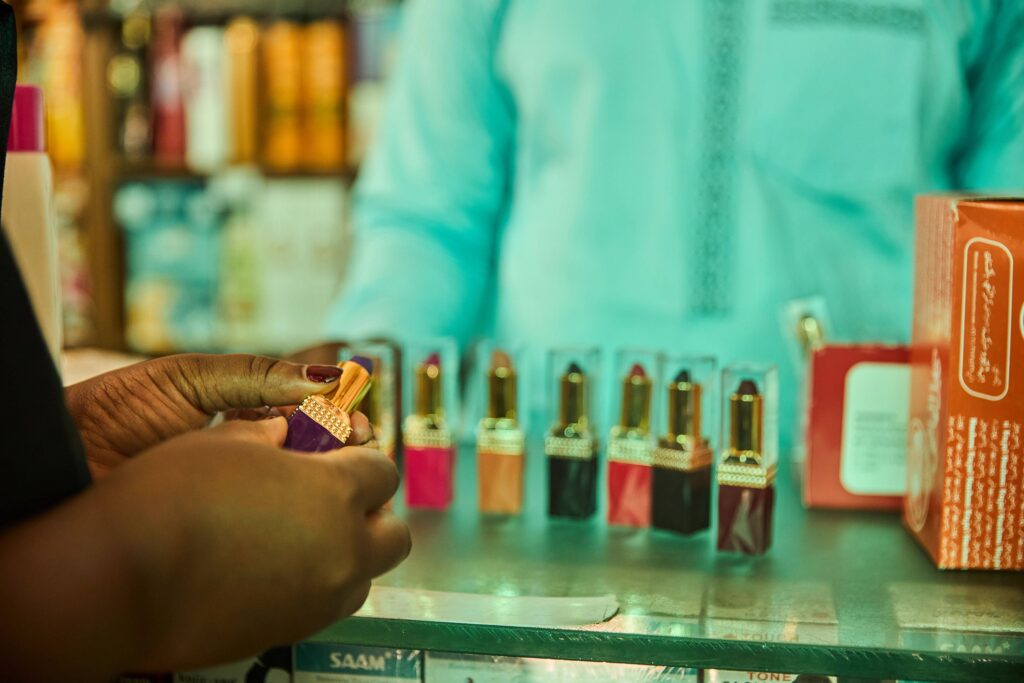
As the National Policy and Action Plan for Lead Poisoning Prevention neared approval in 2025, another nationwide policy was advancing within the FMHSW: one that aimed to improve the safety of cosmetics. Due to recent work from partners in similar contexts, RTSL knew that cosmetics—such as eyeliner, lip balm, nail polish, and hair dye—could be a major source of lead exposure. Traditional eyeliner, known as tiro, is tied to the cultural practices of some of Nigeria’s largest ethnic groups, making its use particularly prevalent and worthy of further investigation.
This presented an opportunity to translate the upcoming lead action plan into concrete practice using one source: advocate for the inclusion of lead as a key contaminant within the cosmetics safety policy, then implement the policy by testing for and addressing exposure.
Unlike other lead exposure sources that would require coordination across multiple government sectors to regulate, cosmetics in Nigeria are largely overseen by only two existing RTSL partners from other health-related initiatives: the FMHSW responsible for the National Policy and Action Plan for Lead Poisoning Prevention, and the National Agency for Food and Drug Administration and Control (NAFDAC). And as both partners were agreeable to the recommendation, this made for swift inclusion of lead within the cosmetics policy—with the policy passing in the fall of 2025.
One of the most difficult things for lead poisoning prevention work is that it is such a big problem. Where do you start? How do we start? Cosmetics was both a suspected public health risk and very amenable to immediate action, given the existing policy opportunity and trusted partners of ours in this space.
Dr. David Berendes, Senior Technical Advisor for Lead Poisoning Prevention, Resolve to Save Lives
Impact: Cosmetics as a blueprint for addressing lead sources
Due to the extensive work of the FMHSW, NAFDAC, and RTSL, the National Policy on Cosmetic Safety and Health, launched just a few weeks after the National Policy and Action Plan on Lead Poisoning Elimination, establishes manufacturing oversight, market surveillance, importation controls, and a national early warning vigilance system for cosmetics across Nigeria—and includes explicit objectives for addressing lead exposure.
With both policies officially enacted, next steps to preventing lead exposure for Nigerian consumers could begin—starting with cosmetics.
These are two different policies but one speaks to the other. They are both key in addressing lead poisoning from cosmetics.
Johnbaptist Ezenduka, Senior Technical Advisor for Lead Poisoning Prevention, Resolve to Save Lives
FMHSW created a technical working group (TWG) to implement the cosmetics safety policy in early 2026. The working group—which meets quarterly— includes FMHSW, NAFDAC, and several other stakeholders including the Standards Organization of Nigeria (SON), the University of Ilorin and RTSL.
In its initial meetings, the group defined a workplan for the year to prioritize activities from the policy for implementation. RTSL, in collaboration with government partners, supported the advancement of lead-specific implementation efforts across four pilot states, following the basic approach outlined in WHO’s forthcoming PREVENT technical package. With the goal of establishing a regulatory limit for lead in cosmetics with NAFDAC, members of the group including RTSL, government parters, and an academic partner tested more than 1,000 cosmetics products for lead, clearly documenting the public health risk and need for regulation. RTSL further mapped the legal regulatory landscape across the pilot states, identifying gaps and suggesting additional policies, standards or other interventions that would support lead elimination in cosmetics, and led capacity strengthening efforts for lead testing by developing and delivering training for environmental health officers and assessing the current capabilities of 47 laboratories.
Focusing on one source of lead exposure streamlined efforts and allowed for meaningful, simultaneously progress across policies within a short period of time. Lessons learned and infrastructure built for regulating lead in cosmetics provides a prototype for future work to identify and eliminate lead in other sources, such as food and cookware.