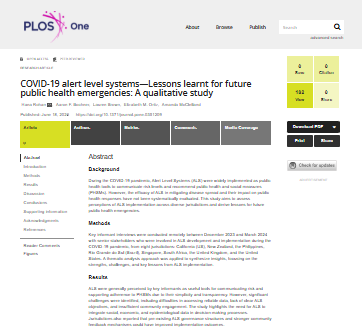
This qualitative study, published in PLOS ONE by Resolve to Save Lives researchers and collaborators, examines how countries used alert level systems during COVID-19 to communicate risk and guide public health responses. Researchers interviewed senior health officials across eight jurisdictions, including the United States, South Africa, Singapore and New Zealand, to identify what worked and what didn’t.
Alert systems were most effective when built on clear objectives, transparent decision-making and genuine community engagement, rather than top-down communication. Countries that developed governance structures before the crisis fared better than those that improvised under pressure. This research reinforces why preparedness systems must be in place before outbreaks strike.