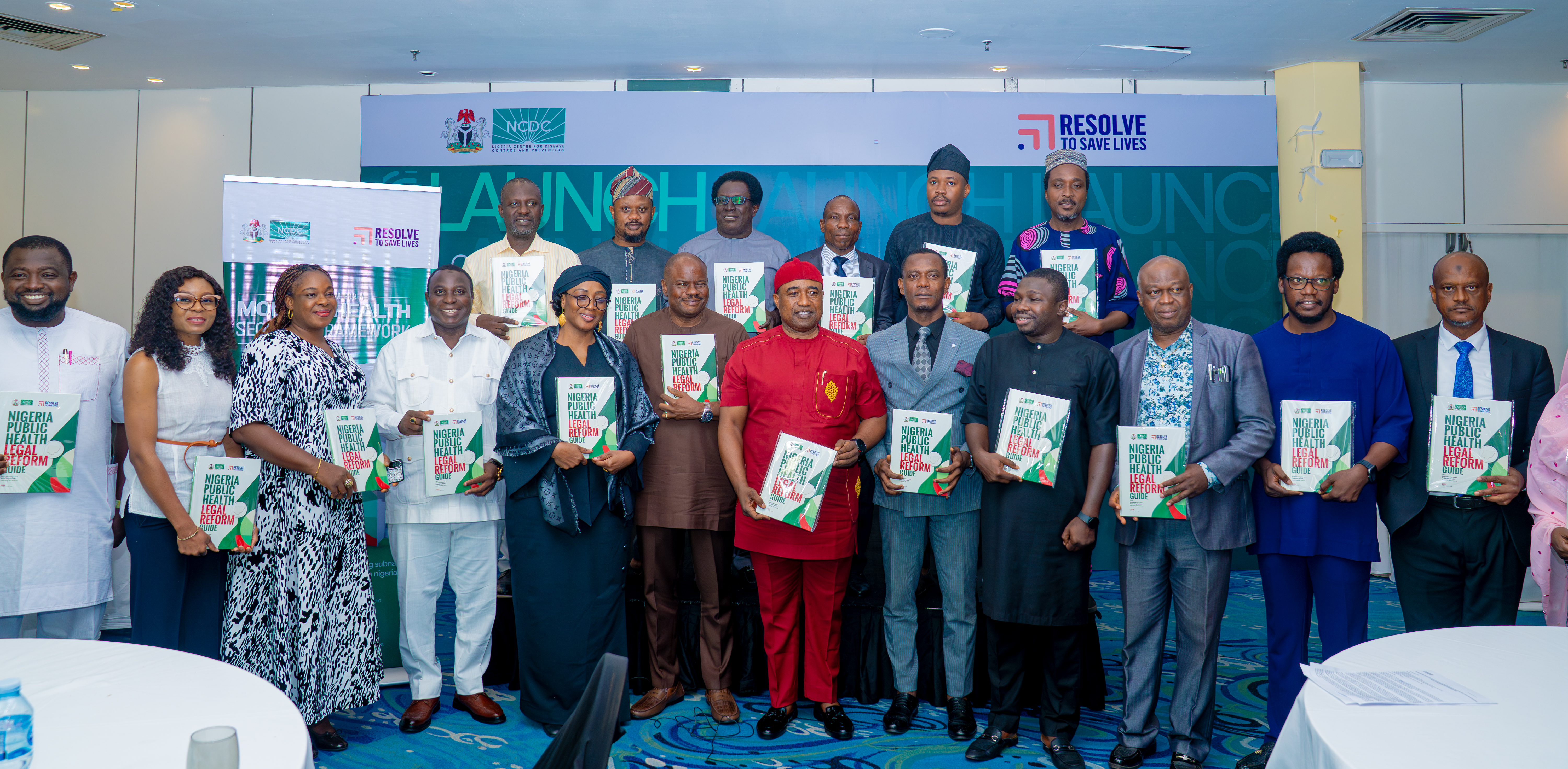
Resolve to Save Lives (RTSL) partnered with the Nigeria Centre for Disease Control and Prevention (NCDC) to launch the Nigeria Public Health Legal Reform Guide, which provides a practical pathway for states and other stakeholders to assess and modernize public health laws.
“[The Guide] will help states modernize their public health legal structures to keep pace with emerging disease threats, evolving institutions, technological advances and Nigeria’s obligations under the International Health Regulations (2005),” said Deputy Director and Head of the Subnational Readiness Strengthening Division at the NCDC, Dr. Everistus Aniaku, who represented NCDC Director-General Dr. Jide Idris at the launch. “National health security is only as strong as the systems at the subnational level.”
In Nigeria’s federal system, strengthening legal preparedness at the state level is particularly important to ensure that health security priorities are effectively implemented across the country. The Guide draws on lessons from RTSL and NCDC’s collaboration since 2019 to strengthen public health legal preparedness at the subnational level. The work has supported states to assess their legal frameworks, identify gaps and advance reforms, contributing to the enactment of new public health legislation in Kaduna, Kano and Jigawa, while other states have advanced draft legislation.
It also brings together tools and lessons from legal reform efforts to help stakeholders develop reforms that reflect their legal, institutional and public health contexts.
The Attorney-General of the Federation and Minister of Justice, Lateef Fagbemi, SAN, represented by Assistant Chief State Counsel at the Federal Ministry of Justice, Piribonimibo Harry, described the Guide as a timely resource for advancing legal reform, and underscored the importance of law in strengthening public health preparedness and response: “The law provides the authority for public institutions to act, defines institutional mandates and responsibilities, establishes mechanisms for coordination, protects individual and community rights, and provides the foundation upon which public resources and governmental powers may be lawfully deployed,” he said.
Also speaking at the launch, Dr. Jenom Danjuma, Interim Country Director, Resolve to Save Lives Nigeria, emphasized that public health legal reform requires collaboration across sectors. “Public health legal reform is not the responsibility of lawyers alone. It requires the collective leadership of public health professionals, policymakers, legislators, regulators, communities, and other stakeholders working together towards a shared objective,” he said.
He reiterated RTSL’s commitment to working alongside NCDC, Federal and State Governments, and partners to strengthen the legal foundations for public health preparedness and response across Nigeria. “We will continue to support efforts that strengthen legal preparedness, promote institutional accountability, and enable governments to respond more effectively to public health threats,” he said.